

Lectio Divina
WA Spiritual Exercises 2026

Now I intend to allure her, lead her into the wilderness, and speak tenderly to her. From there I will restore her vineyards to her and make the Valley of Achor a gateway of hope. There she will respond as she did in the days of her youth, when she came up from the land of Egypt. On that day, says the Lord, she will call me, “My husband.”
Hosea 2:14-18
Now I intend to allure her
In this passage God speaks to us through his prophet, and as He does throughout the Bible he compares our relationship to him to that of spouses. When first encountering a beautiful woman a man notices some half dozen features - her hair, her smile, her figure maybe some element of personality, her kindness or respect - and from these initial impressions, from this, “You had me at hello” he is drawn to come to know her more deeply, more intimately. He finds her alluring, and I imagine for her part she finds his confidence in approaching her also alluring. This is the initial recognition that there is something good here, something attractive.
So to in our relationship with God, we are first drawn by some vaguely defined characteristics and only then do we engage in the work of coming to know Him. Perhaps it is His beauty as found in nature, or his power as found in the act of creation, or perhaps the awe and authority our mentors or the saints have toward Him. Perhaps it is that even more indescribable movement of the Holy Spirit who tells us without words of Gods sweetness. Regardless we each have that first indescribable movement in us that makes God and his Church alluring.
And so we find ourselves attracted to the Divine, engaged in the early stages of seduction, of falling in Love. Pope St John Paul II describes the Bible as “Gods love letter to his children” From the first act of creation all the way to revelation of the New Jerusalem the Scriptures describes the perfect unwavering desire God has for our good. If all you ever did when you read His love letter to you was ask yourself, “What does He who most loves me desire me to learn from this passage?” you would be engaging in excellent Lectio Divina, anything else I might say on the topic - and I do have much more to say - is just details.
Lead her into the Wilderness
Just as a man has to see past all the commotion, noise and (in a more civilized state than that of California) the smoke filled atmosphere of the bar to see his beloved. Just as a man must leave his friends, his home town and his mentor “in order to see about a girl.”, and just as she must leave the security of her friends, family and indeed of the attentions of other men in order to go off with this one and to learn about him, so to we are drawn away from our comforts, our weakness and are called to engage in…we know not what. Our soul is called, by he who loves us most, to enter the wilderness.
How do we navigate this wilderness, this Sacred Scripture to which God has lead us? We might start with some simple observations about how to prepare to read the Bible, to read this love letter. We need not go any further then to ask ourselves, how do I read any book? Just as our young man at the bar has to see beyond the chaos and the noise, we must look beyond our social medias, phones, emails, news, business both family and professional, and so we must set apart some time and space to encounter our Divine Lover. I will confess that my own habit of reading has decreased dramatically over the last decade and I think it has very much to do with not having a particular time and place, let alone the silence to engage in reading. What was once a way of moderating boredom before bed or in the odd hours of down time, what was once an easy activity to turn to, is now something we specifically have to carve out of our noisy and busy lives. This is why the first and central question, What does he who most loves me desires that I learn? Is so important, because by reminding myself that this is a love letter, I provide a powerful motivation to cut through the noise and enter the silence of the wilderness, for it is only there that I can hear what He has to say to me.
In addition to a quiet time and place let me add that a notebook might also be useful. As you can see I am going to present a set of questions to ask yourself as you engage in your practice of Lectio. It can be helpful to write down our answers to these questions. Indeed if we are to treat the Bible as a love letter, we do well to learn how to regularly write back to our Beloved.
And speak tenderly to her
Lectio simply and Literal sense of scripture
While it may seem unnecessarily obvious to say - it nevertheless has special significance when dealing with a four thousand year old text that when we read something we must first understand the words on the page! Mortimer Adler, in his book How to Read a Book starts with what he calls elementary reading or the ability to recognize the words and sentences on the page. However with a text like the Bible a special question is presented, which translation ought we to use?
We, especially we Catholics, ought to recall that the Latin translation of the Bible holds a special place in the Church and we can only benefit from some familiarity with the Latin text. An easy place to start would be with common texts we use regularly - the Benedictus and the Magnificat - would be good places to start those who pray the liturgy of hours. The Pater Noster or the Ave Maria would be an excellent beginning for any Catholic.
However, it would be an intolerable - and an unnecessary burden - to require anyone who wanted to read the Bible to take the two years necessary to learn enough Latin to do so, the next best thing of course would be to have access to multiple translations. No two languages have perfect one-to-one correspondence in the meaning of their words and thus it helps to see what meaning or secondary sense of a particular word is chosen by the various translators of the text. This is especially useful when we consider proper nouns in the Bible, House of Bread is a profoundly evocative place name which the word Bethlahem fails to communicate to the average reader. So to the parallels between certain characters in the bible is made all the more obvious in the original languages when one realizes that the names Jesus and Joshua are the same name. Of course the whole interplay between numbers and people can only be seen with reference to the original languages for example the name David is the same as the number 14 and thus the significance of the Mathew’s genealogy as an affirmation of Christs kingship is all the more profound. The most powerful example of how multiple translations can help would be the question our Lord poses to Peter, Do you love me?
If you recall the story our Lord meets Peter after His crucifixion and asks him three times, “Do you love me?” And while in English this looks all well and good, and a nice way of absolving Peter of the triple denial of Christ on Good Friday, it is in fact much more than that given that the words for love are different words in the Greek the evangelist choose to write in! Christ is in effect asking two different questions which because of the poverty of the English Language look the same! I’ll leave the resolution of that story and why it might be important to your Lectio.
In short, if you wish to be able to hear the words of He who most of all loves you, and you can’t take the time to learn the language his Bride the Church has chosen to speak to him in for the past two thousand years, the next best thing is to have a variety of translations. Pick one that works for you, the New American Bible is used at Mass, the Ignatius bible is the Revised Standard Translation, the Challenor Rheims (my personal favorite) is an updated version of the Douay Rheims. If you love the sound and rhythm of the English language the King James Version is the only obvious choice.
I will restore her vineyards
Meditatio
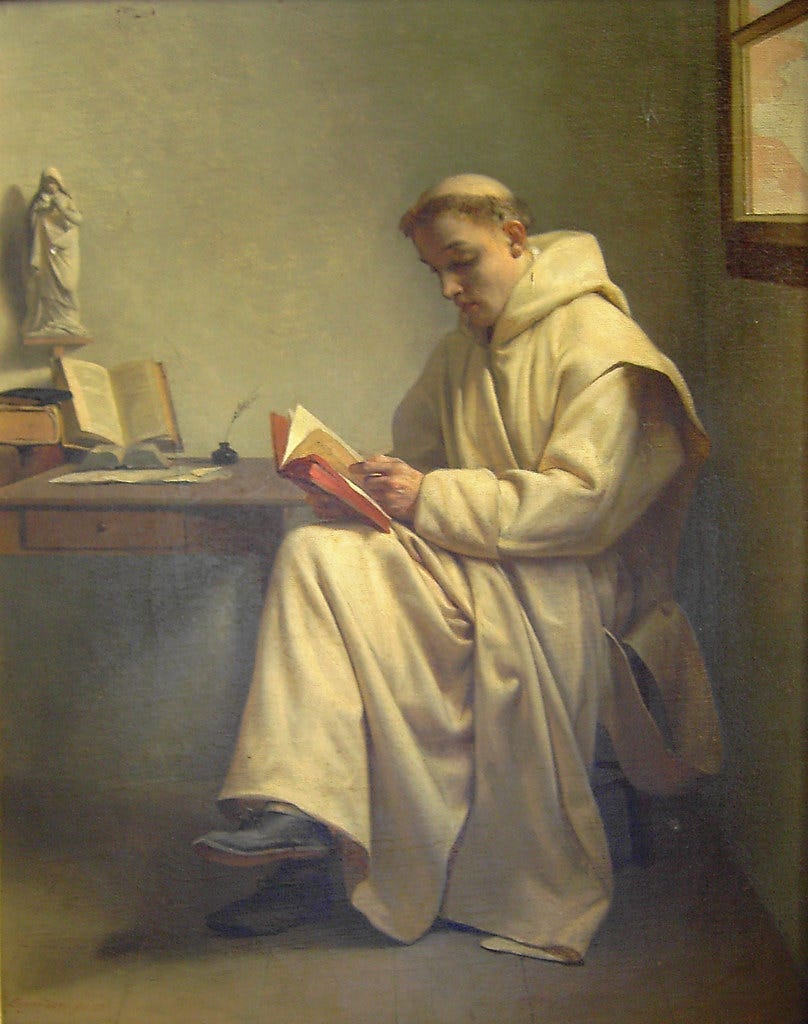
Guigo II, a Carthusian monk around the time our Order was founded, described the work of reading scripture, lectio, as the first rung in a ladder of the spiritual life. The other three steps, which lifted the monk as it were from the Earth to the hights of heaven are meditatio, oratio, and contemplatio. This first step considered the outer layer of the words. This overlaps nicely with Mortimer Adler’s first stage of reading, by which we consider the simple and obvious meaning of the words, but it is by meditatio, by ruminating on the words and their various possible meanings that we come to a more complete understanding of God.
As with any text, merely recognizing the words on the page is not sufficient to understanding the authors meaning. To cite Mortimer Adler again, his second and third stages of reading - the inspectional and analytical stages - are necessary to understand the meaning of the words in light of their context and the author’s intention. Here again, as with the question of the words in their simple meaning, the Bible presents some special problems for us. A book written over the course of 2000 years and while it has a single divine author He did nevertheless choose a wide variety of people, writing styles, and literary genres to inspire and express himself through. This perhaps at risk of straining our metaphor is even more of a wilderness than simply leaving our noise and comfort of our lives, but to try to bring order and understanding to 73 different books.
Nevertheless just as our young man has successfully caught the attention of the beauty at the bar, and just as he has has successfully landed his pick up line he must now show her that the initial attraction, the first stages of seduction were not ephemeral show, but rather the foretaste of a whole host of excellences, of virtues, of strengths, of resources by which he can help to perfect her. So to our Lord, having whispered to us through the liturgy, or the lives of the saints, or the history of the church or any of the numerous ways he draws us to him, must now through his love letter show us how he intends to perfect us, to make us the best versions of ourselves, in short he must establish vineyards in the wilderness.
In addition to having recourse to a variety of translations of the text I wish now to offer a second tool which can help us to understand the Divine Authors intentions for our good, in any particular book or passage of scripture: A division of the text.
A textual division is a way of explaining how all the parts of document relate to the documents purpose. For example if we wanted to compose a document about how a people should be governed we might expect a section on the executive, legislative, and judicial branches. So each of the books of the Bible exist to play a roll in helping us to have eternal life with the God who loves us. To this end our Divine Lover presents a series of instructions about how to live this life, or commandments in the Old Testament and then he provides us particular help in living out these commandments in the New Testament. And so when we read a text of the Old Testament we might ask ourselves, What are Gods commandments for me, what is he telling me to do, or in the New Testament, What help is he giving me in order to live out his commands?
This division of the text - which I am cribbing from the Angelic Doctor - continues by further dividing each testament into two parts. First the Old Testaments Binds the people of God to the commandments (largely in the Pentatuch and the Prophets) and in the second part of the Old testament it warns us what will happen if we do not follow his laws (this he does in the Wisdom literature and Histories). So to the New Testament explains the origin of divine Grace in the Person of Christ, in the Gospels, and then demonstrates the power of his grace in the life of the people, his Church in the Acts and Epistles. And so on down to the particular books themselves. And so we have another set of questions to ask ourselves as we read sacred scripture, What instructions is God giving me? What will happen if I do not follow these commands? What was the life of Christ like, and how can I imitate Him?
In order to make a long story short and an even longer speech not quite so short, I will dispense with the particulars of St Thomas Division and jump down to a few of the individual books themselves simply as examples I do include a full list of books major themes in the handout:
When we read Genesis we might ask ourselves, Who are the individuals involved here? Not merely their name but their relationship to me as well. Adam is the Father of the species, Abraham the Father of the Chosen People and so on. The question we are pursuing becomes, Why is God binding Adam to a particular law? Why is he binding The Father of the Chosen people to a different law? An example from the Gospels might be How does this event in this Gospel illustrate Christs Kingship? How does this other gospel explain his priesthood?
Suffice it to say that each book has a particular purpose in developing our moral and theological virtues, those excellencies of habit which make us able to imitate Christ. By doing this, by asking ourselves questions particular to each text so that we discover the contours and particulars of that texts message to us and as we return to these questions we begin to bring order to the wilderness, like a field plowed over and over, or vines trimmed and pruned throughout the year we establish order, we establish vineyards from which we might drink profoundly of the grace and love of the Divine, which grace and love is fruit of attentively reading and working to understand the revelation of Gods love for us. But like a vineyard this foundation is only established with much labor and patience.
And make the Valley of Achor a gateway of hope
Christological and Aescatological sense, syntopical reading
A man who seeks the love of a woman must not only be alluring and speak sweet words to her, he must display his resources, how he can care for her. It is not enough to lead us into the wilderness but what is more, the God who loves us, seeks to show us that he can make us virtuous, wise and indeed.. However, what I have laid out so far, picking a translation, learning a little latin, reading the text in a quite time and place, taking time daily to examine this letter from the one who loves us, disciplining our reading around a set of questions can seem an all to intolerable burden. And so our Lord offers us some hope in this troublesome effort. He begins to show us who he is. Like lovers, they begin to bear the burdens of life together because they have learned to trust that this other person has the greatest concern for me. By revealing himself, in this next tool of Lectio and Meditatio we begin to taste the joy that can only come from being in the presence of the one who loves us, even though all else in life can be difficult.
In order to persevere in this study of the Scriptures our Divine Lover offers us much to hope for, the knowledge and possession of himself in love. And so it is that when we are meditating upon the the liturgies in Leviticus, or the endless list of genealogies in Kings, or particular differences between the parables in the synoptic gospels, or the deeds of the valiant men and women in the Old Testament, or the various pieces of advice Paul dispenses to the Churches or seemingly endless repettions in the Psalms, or the granular detailed pieces of advice in the Wisdom literature or the wild and almost inexplicable imagery of the Book of Revelation, even in the midst of all these difficult points of lectio and meditatio, these exacting points of attention which reveal to us the Divine authors intention, context and meaning of His words, we nevertheless have an abundant source of comfort and hope that these efforts are revealing to us the mind and heart of Him who most of all loves us.
This hope comes through a final tool that can aid the reader: the Types or Senses of Scripture. Typology are the four major ways a passage of Scripture can be read: Literally, Morally, Christologically, or Aeschatologically. Many passages, major events, and persons of scripture can be understood to prefigure later persons and events. Indeed St Jerome, the translator of the Latin Vulgate said, everything taught spiritually in the new testament is prefigured physically in the Old.
The first sense, the literal, is much of what we have already covered, it is a simple account of the bare meaning of the text. Let me offer an example, Moses is the Law Giver in the Old Testament, he ascends a mountain and after some time of contemplation and conversation with God he offers a set of commands to the people. This is a literal explanation of what happens, however it is also a prefigurement of the Sermon on the mount. Christ ascends a mountain, in the Gospel of Matthew and from the fruit of his relationship with the Father, he offers a set of commandments to the people, which we have come to call the Beatitudes. By having understood the literal meaning of Exodus, by having engaged in the labor of wrestling with the text, we come to understand the deeper significance of Christs actions. Moses offers a set of rules which bind our external actions, do not covet whereas Christ offers a set of laws which bind our internal dispositions, blessed are the poor in spirit. This sense of reading scripture is called the Christological, where we find deeper meanings deeper explanations for Christs actions in the persons and events of the Old Testament. Of course, this is the Church’s wisdom in always presenting an Old Testament text along with a Gospel text in her liturgies.
And so we are presented with a new series of questions to ask ourselves as we read the Bible, What does this person, event, passage tell me about Christ? We might also do the same with our Lady. Some obvious types or figures of our Lady are the heroines of the Old Testament. Ruth’s humility, Judiths’s love of the virtue of temperance but we might also look to the burning bush, consumed by the divine will but not destroyed by it. So to our Lady wholly dedicated herself, Fiat voluntas tua, and yet was not destroyed or overpowered by this.
Another sense of scripture, another source of joy in our labors is called the Aescatological, or concerning the end times. Here we might look to the passage I selected to govern the order of this presentation. Literally it is about Gods desire to rebuild the kingdom of Jerusalem. Christologically we might make some connection to the blood of Christ at mass given the references to vineyards, but ultimately, it applies to our relationship to God because just as he desired a certain response from the Israelites, they shall call me their husband so too does he desire us to rest in him, for eternity as though we are in the arms of our lover, taken wholly outside ourselves and entered fully into his presence just as he will be, indeed just as he currently is toward us.
Though I present these three tools separately: being attentive to the translation, being attentive to the context of the text by means of division of it, and looking for those elements of a story which tell us about Christ or our Lady these all ought to be going on simultaneously as one reads a particular passage. If we read slowly and attentively, if we have our set of questions written out in our notebook to help guide our meditatio we will not experience it as simple academic drudgery but rather as that constant and delightful search for more and more about my beloved.
Both of these ways of reading scripture, that which informs us about Jesus and that which informs us about the details of eternal life, are sources of hope in the midst of what might otherwise be a dreary study of the an ancient text. For those keeping track these sense of scripture fulfill Mortimer Adlers final stage of reading, the syntopical, by which we explore the same idea as it is presented differently in different texts by different human authors. Because by engaging in this question of the senses of Sacred Scripture we are looking for glimpses of Christ, of our Lady of the Kingdom of Heaven all throughout the Father’s love letter to us.
There she will respond as she did in the days of her youth, when she came up from the land of Egypt. - moral sense and oratio
Up to this point I have offered a series of tools developed by the Church over time to help us understand the literal meaning of Gods revelation to us. I have, in the Christological and Aescatological senses offered a glimmer of hope that the scriptures provide us by showing us the person of Christ, a divine person who loves us and his desire for our eternal happiness. In these three ways, Literal, Christological, and Aescatological our divine lover has laid bare not only himself but the deepest desires of his heart for our happiness.
All of this can seem like mere intellectual formation. However we are not called, nor is it hardly useful, to engage in a strictly intellectual study of the Scriptures. That would be as if the man at the bar only looked up the pretty girl’s LinkedIn profile, or memorized every detail of her personality like the hyper-talky characters in a Woody Allen movie — but never actually let her change him. It’s as if he studied her thoroughly but never had that Jack Nicholson to Helen Hunt moment from As Good as It Gets: “You make me want to be a better man.” In short we must ask, what is our moral life as a response of His Love.
If the old testament teaches anything it is that our own efforts are insufficient to build a life that can unify us with the divine and so only one tool remains. It is not an intellectual tool, but rather it is a tool which only love can wield, prayer. We can in the final analysis only ask for that grace, that gift of divine life which will make us like the one who loves us so deeply. The confidence to ask for what we need from another only comes as a consequence of love. Indeed he tells us as much, when He says to knock, seek, and to ask. Prayer is an old English word which means nothing more than, to ask. It is as though our divine lover is saying, ask of me and I will give you that ability to love me in the very way that I most desire to be loved.
Thus when we read about the law given through Moses we must also ask, Lord give me the desire to love you, to keep your name holy and to honor your sabbath. Lord, give me the prudence necessary to navigate my relationships with my parents, my neighbors. When we read about the life of Christ we are compelled to ask, Lord make me perfect as your heavenly father is perfect. By reading the Bible we come to know what we need in order to be worthy of Gods love, by asking for what we need, we draw closer to the one who loves us.
Lectio Divina is the work that leads to prayer, and humble prayer is that recognition of our dependence upon God for all that is good and this recognition, this humble request for his grace rewards us with the peace of contemplation.
On that day, says the Lord, she will call me “My husband.” - contemplatio
Of course the culmination of our being lured into the wilderness, of having sweet words spoken to us, of our being shown the vineyards of the Lord and his hope for our happiness, the final goal of our own response our youthful joy in his presence is to rest, to be still, to be at peace with the spouse of our soul. It is this peace, this rest, this joy which all our labors have sought. There is very little that might be said here, for resting with one who loves us is an experience that exceeds description and often is diminished in making the attempt. After all this talk, if I have done my job, I have enflamed in you a desire to open the Scriptures more and more — “because when you realize you want to spend the rest of your life with Someone, you want the rest of your life to start right away.”
I will close by offering the final words of Guigo II on this topic:
Now it is time for us to end our letter. Let us beseech the Lord together that at this moment He will lighten the load that weighs us down so that we can look up to him in contemplation, and in days to come remove it altogether, leading us through these degrees from strength to strength, until we come to look upon the God of gods in Sion, where His chosen enjoy the sweetness of divine contemplation, not drop by drop, not now and then, but in an unceasing flow of delight which no one shall take away, an unchanging peace, the peace of God.
So my brother, if it si ever granted to you from above to climb to the topmost rung of this ladder, when this happiness is yours, remember me and pray fro me. So, when the veil between you and God is drawn aside, may I to see Him, ‘and may he who listens say to me also: Come.